Sinkhole Detection Using a Through-Ice 3D Sonar System
Executive Summary
This publication describes a through-ice 3D sonar survey conducted at the Shikwamkwa Dam near Wawa, Ontario to assess potential sinkholes at the toe of a saddle dam. The survey methodology enabled high-precision underwater assessment using a stable ice platform and integrated sonar positioning technologies.
The paper demonstrates how portable sonar systems can support cost-effective inspections of critical infrastructure while providing detailed underwater surface models for engineering evaluation and stability analysis.
Publication Details
Publication: CDA Bulletin Magazine
Date: February 2025
Technical Overview
The publication outlines AquaCoustic’s through-ice 3D sonar survey methodology used for underwater dam inspections and sinkhole detection. The sonar system incorporated precise positioning sensors, calibrated sound velocity measurements, and point-cloud processing workflows to generate accurate underwater surface models.
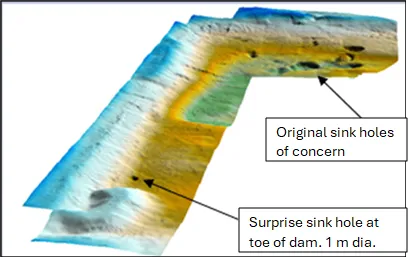
The case study demonstrates how sonar data was used to identify both known and previously undiscovered sinkholes beneath the saddle dam, supporting further engineering analysis and infrastructure risk assessment.
Key Contributions
Through-ice deployment methodology for underwater sonar inspections
High-precision underwater point-cloud generation
Detection of previously unidentified sinkhole conditions
Integration of sonar data into engineering and CAD workflows
Cost-effective inspection approach for critical infrastructure monitoring
Infrastructure Implications
Through-ice sonar inspections provide dam owners and infrastructure managers with detailed underwater condition data that can support risk assessments, maintenance planning, and long-term infrastructure monitoring.
Portable sonar systems also allow critical underwater inspections to be completed efficiently in remote environments while minimizing operational disruption.